 Available in US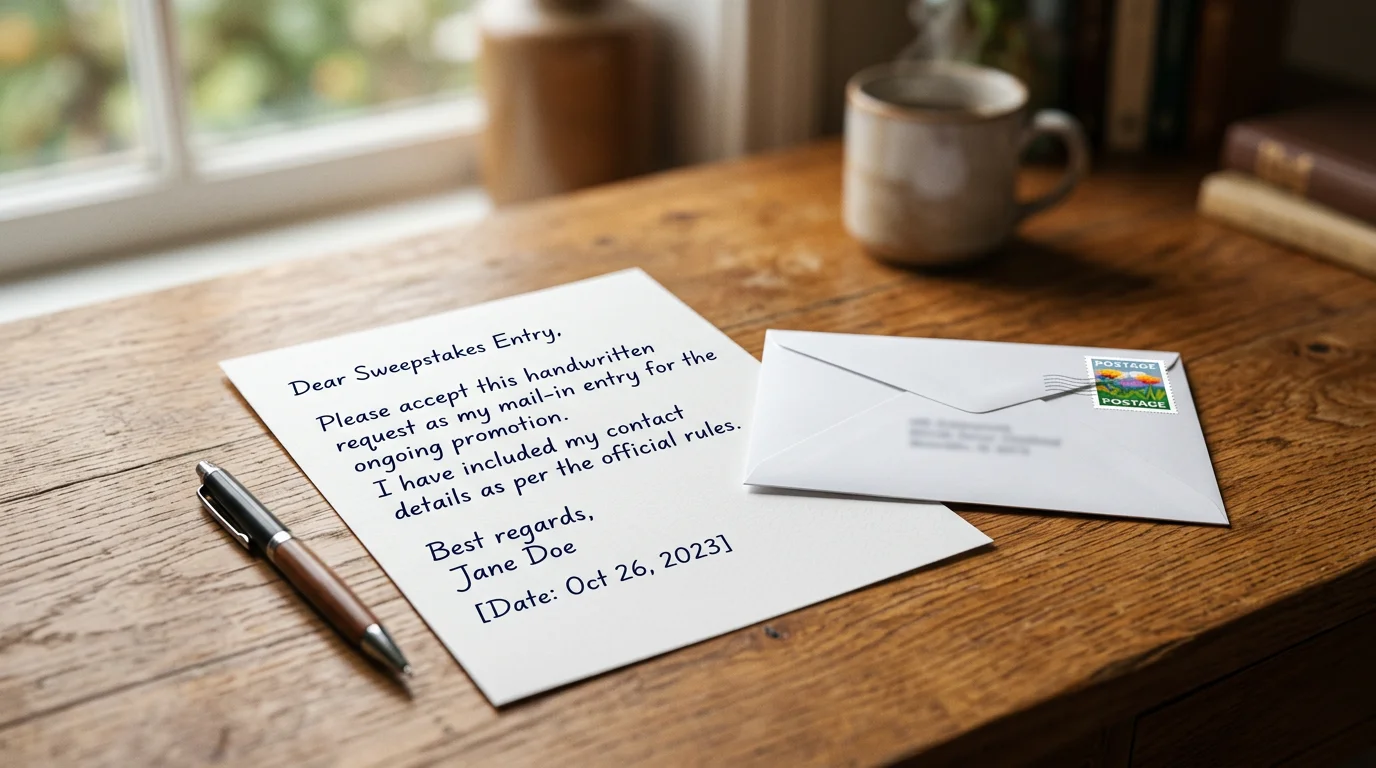
The sweepstakes casino mail-in bonus is the most overlooked free entry method in the industry — and, legally, the most important. AMOE — Alternative Method of Entry — is the mechanism that keeps the entire sweepstakes model on the right side of promotional sweepstakes law. Without it, the argument that sweepstakes casinos are not gambling collapses. As EKG Managing Director Matt Kaufman has explained, sweepstakes casinos do not meet the legal definition of gambling because they lack one of the three required elements: consideration. The free-play mode and the AMOE process eliminate the requirement to pay, which is what distinguishes a sweepstakes promotion from a gambling operation in most U.S. jurisdictions.
For players, AMOE is simpler than it sounds: you send a letter, you get free Sweeps Coins. No purchase, no payment information, no strings beyond the cost of a stamp and an envelope. Free coins, one stamp at a time — and over weeks of consistent mailings, those coins add up to a meaningful SC balance.
Step-by-Step AMOE Guide for Requesting Free SC
The AMOE process is deliberately analog in a digital world — and that is by design. The physical mail requirement creates a barrier that is low enough to satisfy the legal “free entry” standard but high enough that most players will not bother, which keeps the process from being exploited at a scale that would undermine the platform’s economics. Three quarters of sweepstakes players never purchase Gold Coins, according to SPGA data, and AMOE is one of the methods that free-to-play majority uses to accumulate SC.
Step 1: Locate the AMOE instructions. Every legitimate sweepstakes casino publishes its AMOE requirements in the Terms of Service or a dedicated “Alternative Method of Entry” page. The instructions specify the mailing address, the required format of the letter, and any restrictions on frequency. These details vary by platform — do not assume one platform’s AMOE rules apply to another.
Step 2: Write the letter. Most platforms require a handwritten request on a standard 3×5 index card or a sheet of paper placed inside a standard #10 business envelope. The letter must include your full legal name (matching your account), your registered email address, your physical mailing address, and a statement requesting free Sweeps Coins. Some platforms require you to write the specific phrase “Request for Sweeps Coins” or include your account username. Printing or typing the letter is usually not accepted — handwritten is the standard.
Step 3: Address and mail the envelope. Write the platform’s AMOE mailing address on the envelope. Use a standard first-class stamp ($0.78 as of 2026). Do not send multiple requests in the same envelope — each envelope counts as one entry. Drop the letter in a mailbox or take it to a post office.
Step 4: Wait for processing. The platform receives your letter, verifies the information against your account, and credits the Sweeps Coins to your balance. This process is not instant — expect 7 to 21 days from the date you mail the letter to the date the SC appears in your account. Some platforms are faster; others are slower. There is no tracking mechanism for individual AMOE requests, so patience is required.
Platform-Specific AMOE Rules
Each sweepstakes casino sets its own AMOE parameters — the number of SC per request, the frequency limit, and the mailing address all differ. Here is how the major platforms handle mail-in entries.
Chumba Casino provides 5 SC per mail-in request. Requests are limited to one per day. The mailing address is published in the Terms of Service. Chumba’s AMOE is among the more generous per-request allocations in the industry — at 5 SC per letter, 20 letters per month yield 100 SC, which meets the platform’s minimum redemption threshold.
LuckyLand Slots follows a similar structure to Chumba (same parent company, VGW). The SC per request and frequency limits are comparable, though the specific mailing address differs.
Stake.us offers Stake Cash via AMOE. The amount per request and frequency limits are specified in the platform’s Terms. Stake.us’s AMOE process uses the same handwritten-letter format as other platforms.
WOW Vegas accepts AMOE requests with a daily frequency limit. The SC per request is typically in the 5–10 SC range, making it one of the more worthwhile platforms for consistent mail-in players.
Pulsz, McLuck, and High 5 Casino all offer AMOE with varying SC amounts per request. The allocations tend to be smaller — 1–5 SC per letter — and frequency limits of one request per day are standard.
Always check the current Terms of Service before sending your first letter. Platforms occasionally update AMOE rules — changing the SC amount, the mailing address, or the frequency limit — and sending a request using outdated information may result in the letter being discarded without credit.
Expected Wait Times
AMOE processing timelines are the least predictable element of the entire sweepstakes experience. The industry standard is 7–21 business days from mailing to SC credit, but actual wait times depend on several factors.
Mail delivery time accounts for the first 2–5 business days. First-class USPS mail within the continental U.S. typically arrives within this window, though delivery to out-of-state addresses may take longer. There is no expedited option that matters — platforms process AMOE requests on their own schedule regardless of how quickly the letter arrives.
Internal processing time at the platform adds another 5–14 business days. Larger operators like VGW handle thousands of AMOE requests monthly and batch-process them rather than handling each letter individually. Smaller platforms may process faster simply because their volume is lower. Seasonal spikes — particularly after new promotional campaigns drive awareness of AMOE — can extend processing times across the industry.
The most effective AMOE approach is to treat it as a recurring task rather than a one-time effort. According to RG.org data citing Optimove research, only about 12% of sweepstakes players ever convert to a paid purchase. For the other 88%, mail-in entries represent one of the most reliable channels for building a redeemable SC balance — slow but free, and cumulative over time.
Is AMOE Worth the Effort?
The math is straightforward. A first-class stamp costs $0.78. A #10 envelope costs approximately $0.05–$0.10 if purchased in bulk. An index card is a few cents. Total cost per AMOE request: approximately $0.85–$0.95.
If the platform awards 5 SC per request (as Chumba does), you are receiving $5.00 in redeemable value for roughly $0.90 in materials and postage — a return of roughly 5.5:1. Even at 2 SC per request ($2.00 value), the return is better than 2:1. By comparison, purchasing Gold Coins at the best available rates delivers SC at an effective cost of $1.00–$2.50 per SC. AMOE is cheaper by a wide margin.
The tradeoff is time and consistency. Each letter takes 3–5 minutes to write, address, and seal. Mailing daily requires a modest habit-building effort. And the 7–21 day processing window means you are operating on a delayed gratification schedule rather than an instant-credit one. For players who value the free-to-play aspect of sweepstakes — and there are millions who do — AMOE converts the cost of a postage stamp into real, redeemable Sweeps Coins. Free coins, one stamp at a time, add up faster than most players realize.