Best Non GamStop Casino UK 2026
Loading...
Sweepstakes casino table games sit in the shadow of slots — and that is putting it politely. Slots account for the overwhelming majority of game libraries and player activity across every major platform. But beyond the slot reels, a growing number of sweepstakes casinos now offer blackjack, roulette, baccarat, and video poker in Sweeps Coin mode. The selection is thinner than what regulated iGaming sites provide, and the rules sometimes carry tweaks that affect strategy. Still, for players who prefer skill-influenced games over pure chance, the table game category is where the sweepstakes model gets genuinely interesting.
The challenge is finding platforms that take table games seriously. Out of the 140+ sweepstakes sites now operating in the U.S. — a number that has surged as more than 25 new brands launched in 2025 alone, according to Waterhouse VC — only a fraction offer more than a token selection of table games. This guide covers what is actually available, which platforms deliver the best experience, and what to know before you sit down at a virtual table.
Blackjack at Sweepstakes Casinos
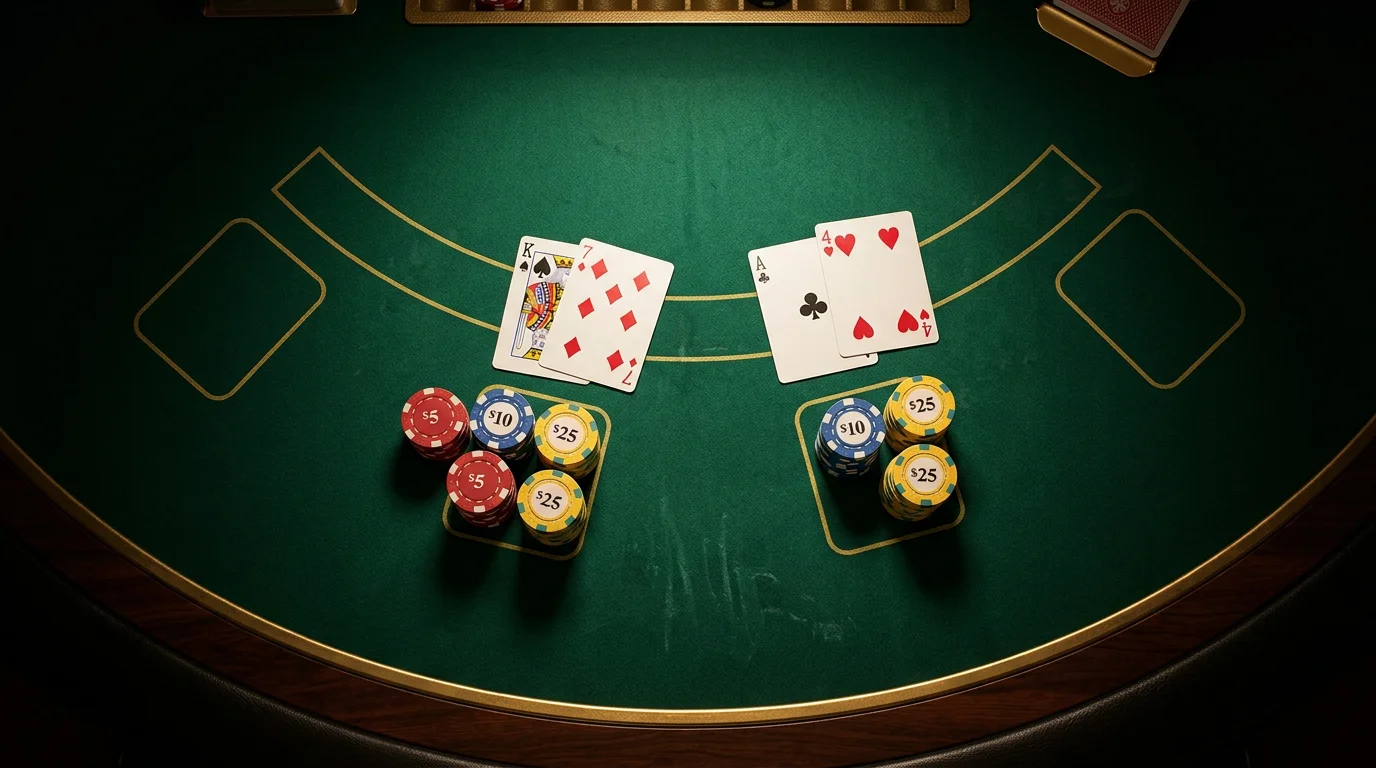
Blackjack is the most widely available table game in the sweepstakes space, and it is the one where the gap between the sweepstakes experience and the regulated casino experience is most apparent.
Most platforms offer at least one variant — typically a standard multi-hand blackjack where you can play one to three hands simultaneously against a virtual dealer. The core rules are recognizable: hit, stand, double down, split pairs, insurance when the dealer shows an ace. Some platforms add side bets like Perfect Pairs or 21+3, though these are less common than at licensed sites.
Where things diverge is in the specifics. Blackjack at a regulated online casino follows published house edge tables — a standard six-deck game with dealer-stands-on-soft-17 carries a house edge around 0.5% with optimal strategy. Sweepstakes platforms generally do not publish the exact rules configuration (number of decks, dealer hit/stand rules on soft 17, blackjack payout ratio), which makes calculating the theoretical house edge difficult. Some platforms pay 3:2 on natural blackjack; others quietly offer 6:5, which significantly increases the house advantage.
The better-equipped platforms for blackjack include Stake.us, which offers multiple variants from several providers and its own “Stake Originals” line, and Pulsz, which carries a handful of blackjack titles alongside its slot-heavy library. Chumba Casino has blackjack available but the variant selection is limited, often to a single proprietary version. McLuck and WOW Vegas both include blackjack, though the number of table game titles on each tends to sit in the single digits.
If you are a blackjack player migrating from regulated online casinos, the key adjustment is this: basic strategy still applies, but you are making decisions without full visibility into the rules that determine your theoretical edge. That uncertainty is baked into the sweepstakes model.
Roulette, Baccarat, and Video Poker
Roulette is the second most common table game at sweepstakes casinos, though “common” is relative. Most platforms that carry it offer European roulette (single-zero) or American roulette (double-zero), with the occasional multi-wheel or speed roulette variant. European roulette has a theoretical house edge of 2.7%; American roulette doubles that to 5.26%. The version available to you matters — and on some platforms, only the less favorable American version is offered.
The roulette interface on sweepstakes platforms tends to be functional but not flashy. You place SC bets on the standard grid — inside bets (straight-up, splits, streets) and outside bets (red/black, odd/even, dozens) — and a RNG determines the result. There is no live wheel, no dealer, and no physics simulation. It is a number generator dressed in roulette’s clothing, which is exactly how virtual roulette works at regulated casinos too. The difference, again, is transparency: licensed operators publish their RNG certification, while sweepstakes platforms typically do not.
Baccarat is rarer. A handful of platforms include it — Stake.us carries a few baccarat variants from its third-party providers — but it is far from standard. The game follows conventional rules: bet on Player, Banker, or Tie, with Banker bets carrying a slight statistical edge (minus the typical 5% commission). For players who appreciate baccarat’s low house edge and simple decision tree, finding a sweepstakes platform that offers it requires some searching.
Video poker occupies an odd middle ground. Technically a machine game, it behaves more like a table game in terms of strategy — Jacks or Better, Deuces Wild, and Joker Poker all reward optimal play decisions. Several sweepstakes casinos include video poker in their libraries, and it may be one of the better value propositions in the space for skilled players. The base paytable determines the theoretical return, and while sweepstakes operators do not publish these tables consistently, experienced video poker players can sometimes infer the configuration from the payouts displayed in the game interface.
Platform-by-Platform Table Game Comparison
Not all sweepstakes casinos treat table games equally. Some build their entire identity around slots and fish games, offering blackjack and roulette as afterthoughts. Others have quietly assembled respectable table game sections. Here is how the major platforms stack up.
Stake.us leads the field for table game variety. The platform carries blackjack, roulette, baccarat, and video poker variants sourced from multiple providers, including BGaming and its own Stake Originals. Stake.us also offers some proprietary “Stake Originals” — simple table-style games with provably fair mechanics, where the RNG output is cryptographically verifiable. For players who care about transparency, these are worth noting.
Pulsz offers a solid mid-range selection. Multiple blackjack variants, European and American roulette, and a few video poker titles. The table game lobby is clearly secondary to slots, but it is functional and regularly updated.
Chumba Casino — operated by VGW, which generated over $4 billion in revenue in its last reporting period — has a surprisingly thin table game offering given its market position. One or two blackjack variants and a roulette game are typically available, but the platform is overwhelmingly slot-focused. VGW’s other brand, LuckyLand Slots, does not offer table games at all.
WOW Vegas includes blackjack and roulette, though the selection is limited to a handful of titles. The platform’s strength lies in its slot library and promotional offers rather than table game depth.
McLuck Casino carries a small but growing table game section. Blackjack and roulette are available, and the platform has added new providers over the past year, suggesting that table game expansion is on the roadmap.
High 5 Casino is primarily known for its proprietary slot content, but it does offer some table games. The selection skews toward video poker and simple card games rather than full-featured blackjack or roulette.
The pattern is consistent: platforms source most of their table games from the same handful of providers, and the variety gap between the best and worst platforms is significant. If table games are your priority, Stake.us and Pulsz are the clear frontrunners.
Why Table Game Strategy Works Differently Here
Table games are traditionally where skilled players can narrow the house edge to its thinnest margin. Optimal blackjack strategy at a licensed casino reduces the house advantage below 1%. Baccarat’s Banker bet carries a house edge of just 1.06%. These numbers assume transparent rules and verified payout configurations — conditions that sweepstakes platforms do not guarantee.
The reported payout ratio across sweepstakes platforms sits between 65% and 72%, according to RG.org research based on EKG data. That figure is blended across all game types, including slots, which dominate player activity and drag the average down. Table games likely return a higher percentage to players than slots do, but without published per-game RTP data, that is an inference, not a fact.
What this means in practice: basic strategy still gives you better outcomes than random play. Hitting on 16 against a dealer’s 10 is correct regardless of the platform. But the magnitude of your edge from optimal play is uncertain. You might be grinding a 0.5% edge down from a 3% house advantage, or you might be trimming a sliver off something larger. The math that makes table games attractive at regulated casinos is partially obscured here.
For players who enjoy the strategic element of table games, the sweepstakes model offers a way to play for potential real-money redemption in states where iGaming is not legal. That is the value proposition. Just understand that the information asymmetry — you cannot fully verify the rules working against you — is part of the cost of entry. Beyond the slot reels, the games are real. The transparency, unfortunately, is still catching up.